
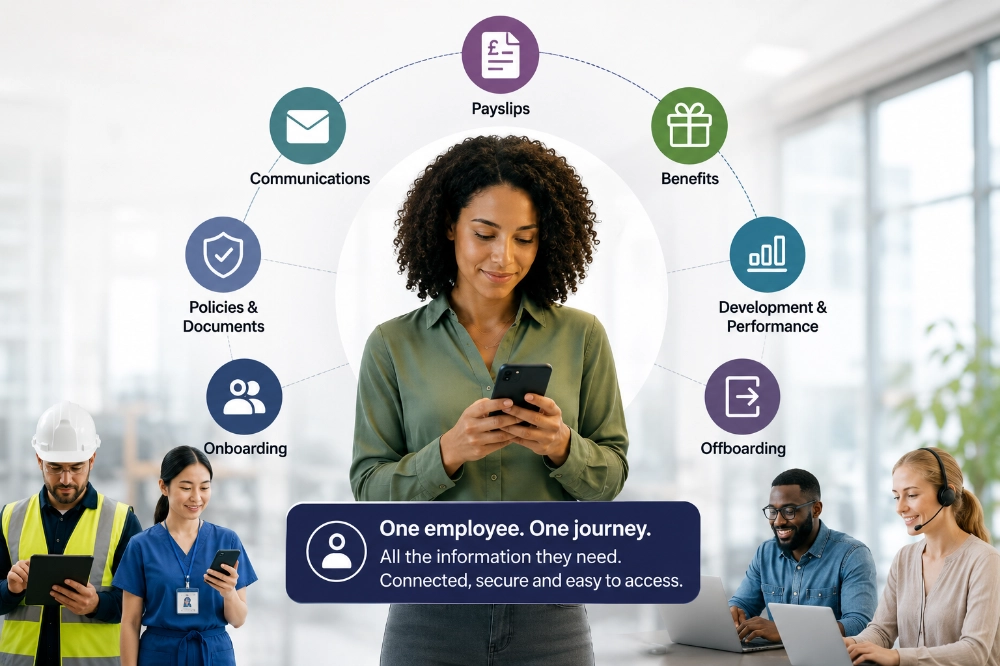
Employees don’t experience HR as a collection of separate systems.
They simply experience their workplace.
Yet behind the scenes, their information can be scattered across payroll platforms, email inboxes, shared drives, benefits portals, HR systems, and paper documents.
A payslip arrives in one place. A policy update somewhere else. Benefits information is stored on another platform. An important HR document gets buried in an email.
Individually, each process might work.
Together? The employee experience can quickly become fragmented and the employee becomes disengaged.
As organisations continue to digitise HR, the next challenge isn’t simply adding more technology. It’s making sure that technology — and the communication it supports — actually connects.
Digital transformation has solved many traditional HR problems.
Paper processes have reduced. Employees can access more information remotely. Automation has removed repetitive tasks.
But introducing separate solutions for every process can create a new problem: digital fragmentation.
Employees may need different logins for different systems, struggle to remember where information is stored, or receive communications through multiple channels.
For HR teams, that can mean:
Technology should make working life simpler not create another layer of complexity.
Throughout our Employee Lifecycle series, we’ve looked at the many different touchpoints that shape an employee’s experience.
From onboarding and engagement to development, benefits, payroll and eventually offboarding, each interaction contributes to how an employee feels about their organisation.
The important thing is that employees don’t see these as separate HR functions.
To them, it’s one continuous journey.
If onboarding feels seamless but accessing a payslip is difficult, that matters.
If benefits are excellent but employees don’t know where to find them, their value is diminished.
If important communications are scattered across different channels, engagement can suffer.
A connected approach considers the whole journey rather than individual transactions.
Whatever stage of the employee lifecycle someone is in, communication sits at the centre of the experience.
Employees need the right information:
At the right time.
In the right place.
…and in a way they can trust.
That might be a contract before their first day, a payslip at the end of the month, information about available benefits, recognition of an achievement, or important documents when they leave.
Making those communications secure, relevant, and easy to access creates consistency across the lifecycle.
And consistency builds trust.
One of the biggest advantages of connected HR technology is creating a reliable place for employees to find what they need.
Rather than searching through old emails or contacting HR, employees can access important information themselves.
For employees, that means:
For HR teams, it can mean:
It’s a simple principle: make it easy for people to find the information that matters.
As we explored in May, not every employee works behind a desk.
Hybrid, remote, frontline, and field-based employees may have very different working environments. However, they still need the same access to essential workplace information.
A connected digital experience helps remove the divide between employees who have constant access to corporate systems and those who don’t.
Secure, accessible communication can help create a more inclusive employee experience — wherever someone happens to work.
The real question for organisations isn’t how many digital HR tools they have.
It’s how well those tools support their people.
A modern HR strategy should make everyday interactions easier, reduce unnecessary barriers, and give employees confidence that the information they need will be there when they need it.
That means looking beyond individual processes and considering how everything connects.
At SSLPost, we believe technology should simplify the employee journey.
ELMhub brings secure employee communication, payslips, documents, benefits, policies and other important information together within one accessible environment.
Instead of employees navigating a collection of disconnected touchpoints, organisations can create a more consistent experience across the employee lifecycle.
For HR, that means greater efficiency and control.
For employees, it means something even simpler:
One place to go. One consistent experience. Less friction.
Over the past few months, we’ve explored ePayslips, employee benefits, security, the deskless workforce, Employee Self-Service, and the changing strategic role of HR.
They may seem like separate subjects.
But they’re all connected by the same principle: great employee experiences don’t happen in isolation.
The organisations that get this right won’t necessarily be the ones with the most technology.
They’ll be the ones that use technology intelligently — connecting people, processes, and communication to create a workplace that simply works better.